
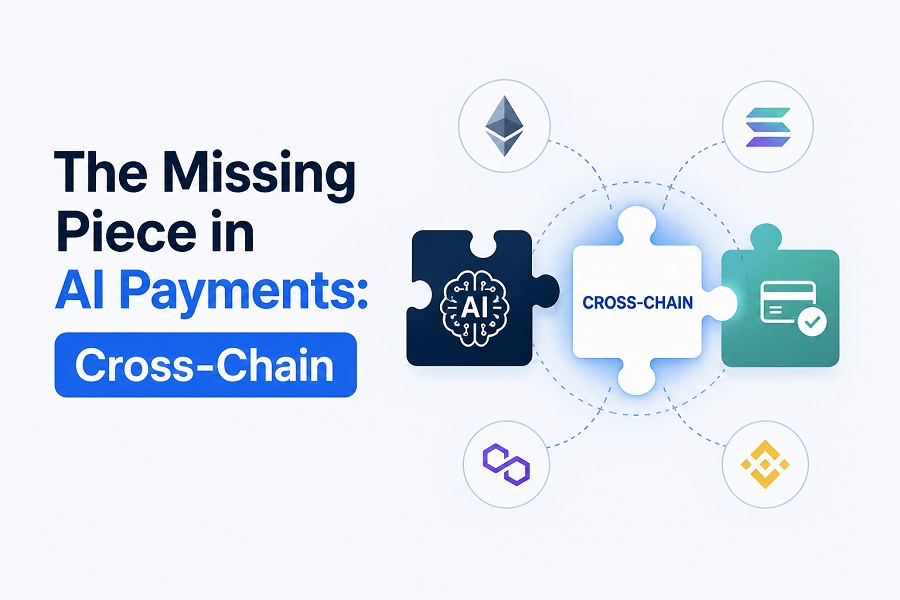
Everyone is talking about payment for AI agents. Almost nobody is talking about what they pay with.
The narrative arc of the last twelve months goes something like this: agents will book flights, negotiate contracts, buy compute, settle invoices, and tip other agents for their work. OpenAI ships agentic checkout. Anthropic builds tool use into Claude. Google and Coinbase rolled out x402 and AP2 – the first serious agentic payment protocols designed for autonomous machine-to-machine settlement. Stripe announces agent-ready APIs. The pieces are clicking into place.
But there’s a hole in the middle of this picture, and it’s getting bigger the closer you look.
The cross chain execution assumption nobody examined
When people sketch out AI payment architectures, they almost always assume the money is already in the right place. Agent needs to pay $4 for an API call? Cool – there’s USDC sitting in its wallet. Agent needs to settle a $200 invoice with another agent on a different platform? Easy – they share a chain.
This works in demos. It does not work in the real world.
In the real world, an agent buying compute on a Solana-native marketplace might be funded with USDT on TRON because its operator runs payroll out of Southeast Asia. An agent settling an EU invoice needs euros, not dollars. An agent tipping another agent in a peer-to-peer protocol might be on Base, while the recipient is on Arbitrum. A consumer paying an agent through a crypto card might be drawing from USDT on Ethereum mainnet, but the merchant settles in USDC on Polygon.
Every one of these flows has a chain mismatch baked in. And every chain mismatch is a payment that doesn’t happen – or worse, a payment that fails halfway through and leaves money in limbo.
Why cross chain hits harder for AI than for humans
Humans are patient. A human will wait three minutes for a bridge transaction, copy-paste an address, switch networks in their wallet, sign two transactions, and curse at the screen. Payment agents doing thousands of micro-transactions per day cannot afford any of that. The economics break.
There are three things that have to be true for AI payments to actually scale:
Settlement has to be deterministic. An agent can’t retry a failed bridge transaction the way a human can – it doesn’t have intuition about what went wrong. Every payment route needs predictable execution, or the agent’s downstream logic falls apart.
Latency has to match the action. If an agent is buying real-time data, paying for inference, or settling between other agents, anything over a few seconds is a non-starter. Cross-chain UX built for humans (multi-minute confirmations, manual claims, wrapped tokens) is structurally incompatible with agentic flow.
The interface has to be programmatic. Agents don’t click buttons. They call APIs. Every crypto payment protocol designed around a frontend with chain selectors and “approve” buttons is invisible to the agent economy.
These aren’t UX improvements. They’re table stakes.
Where Existing Protocols Stop Short
The current generation of agentic payment protocols – x402, AP2, and the agent kits coming out of Coinbase, Stripe, and others – solves a real problem: how an agent authenticates, requests, and confirms a payment. That’s the intent layer.
What none of them solve is the execution layer across chains. x402 happily issues a payment request denominated in USDC. It does not care whether the paying agent holds USDC on the same chain, on a different chain, or in a different stablecoin entirely. That gap is left to “infrastructure” – which, today, means human-shaped bridges with chain selectors and manual approvals.
The result: agentic payment protocols can describe a payment, but they can’t always deliver it. Cross-chain is the missing layer underneath.
What This Looks Like in Practice
Picture a marketing agent running a campaign across three vendors: a copywriting service that bills in USDC on Base, a translation API that prefers USDT on TRON for tax reasons, and a graphic design platform that operates entirely on Solana. The agent’s owner topped up its wallet with $500 of USDT on Ethereum mainnet, because that’s what their exchange paid out.
Without cross-chain infrastructure, this agent does nothing. It can pay one vendor, maybe.
With cross-chain infrastructure designed for agents — programmatic, fast, deterministic — the agent makes three payments in three different stablecoins on three different chains, and the operator never thinks about it. The chain layer becomes invisible, the way TCP/IP is invisible to a web app.
This is what Allbridge AI is building toward: cross-chain rails that an agent can call directly, without bridges-as-frontends, without chain-selection logic, without the human-shaped friction that makes today’s bridges unusable for autonomous systems. It’s a quiet bet, and a correct one – because every other piece of the AI payment stack is being built on the assumption that someone solves this problem.
Where This Goes
The endgame isn’t “agents using bridges.” The endgame is that the chain a payment traverses becomes an implementation detail – chosen by routing logic, not by users or agents. The same way a Visa transaction doesn’t ask the merchant which interbank network to settle on.
When that happens, two things shift:
Stablecoin-native chains specialize harder. TRON keeps its role as the dollar settlement layer for emerging markets. Solana cements its position as the high-throughput consumer chain. Base and Arbitrum compete for DeFi-adjacent agent activity. Each chain plays its role; cross-chain infrastructure makes the roles compatible.
Agent economies cross borders trivially. A US-based agent paying a freelancer agent in Lagos doesn’t need to know that the rails involved went USDC-on-Base – bridged via intent – USDT-on-TRON – off-ramped through a local OTC. It just sends $40. The complexity is absorbed into infrastructure.
This is the boring, infrastructural future of AI payments. Not flashy, but necessary. The teams building agent checkouts, agent wallets, and agentic payment protocols are working on the visible 20% of the problem. Cross-chain is the invisible 80% – and right now, it’s a wall.
The teams who tear that wall down don’t just enable AI payments. They define the shape of the next financial layer entirely.