
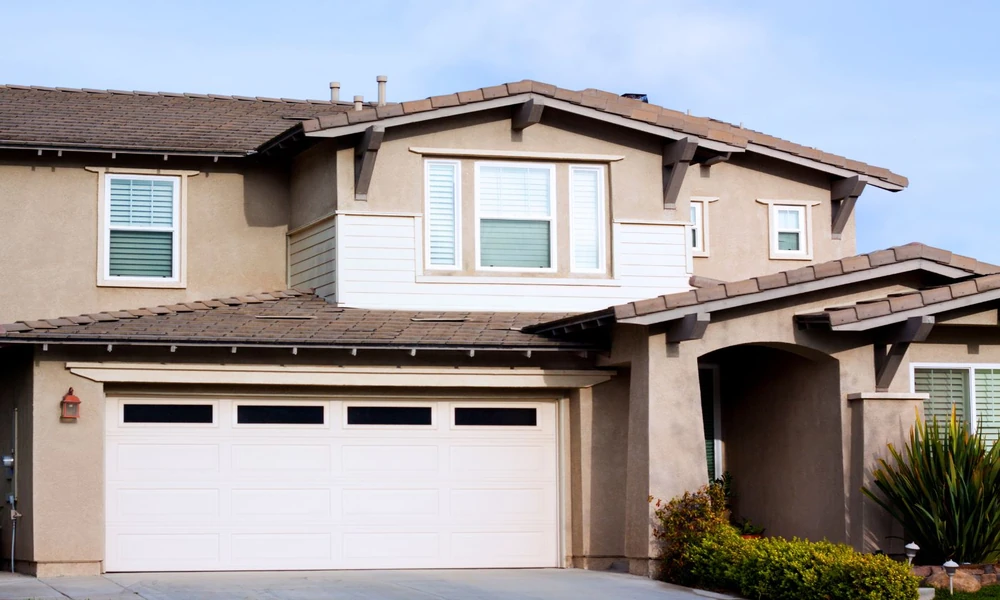
Some houses look finished and some look like they are still waiting for something. The difference is usually the exterior, and stucco is one of the few materials that can change that impression completely.
It has a way of quieting a facade. Brick and siding announce their pattern, while stucco reads as one continuous surface, and the eye takes in the shape of the house rather than the material covering it.
Choosing a Finish That Suits the House
Stucco is not a single look. The texture chosen at the final coat determines almost everything about how the finished wall reads.
A smooth sand finish leans contemporary and pairs naturally with clean rooflines and large windows. A light lace or knockdown texture is more forgiving of shadows and small imperfections, which suits a traditional facade. Heavier textures give a wall depth and a hand-applied character that photographs beautifully in late afternoon light.
Color works the same way. Pigment integrated into the finish coat runs through the material rather than sitting on top of it, which means a chip does not reveal a different color underneath and the wall does not demand repainting on a schedule.
Improving Curb Appeal Right Away
The visual change is immediate, and it is rarely subtle.
A house with mismatched siding, patched repairs, and a dozen small distractions across the front becomes a single calm surface. Trim, doors, and landscaping suddenly have something to stand against, and details that were competing for attention start working together instead.
Buyers respond to this even when they cannot articulate why. A clean, well-kept exterior signals that the rest of the house has been looked after, and that impression forms before anyone reaches the front door.
Standing Up to the Gulf Coast Climate
Houston is a demanding place to put anything on the outside of a building. Heat, humidity, sudden heavy rain, and soil that moves with the seasons all work against an exterior.
Stucco handles that well when it is installed as a complete system rather than as a surface. What sits behind the finish matters as much as the finish itself, since a weather-resistant barrier, correctly installed flashing at windows and doors, and a proper drainage path are what keep water moving out of the wall instead of into the framing.
This is why installer selection carries more weight than material selection. Contractors such as GY6 Built LLC, a veteran-owned Houston company that works on both installation and full system remediation and backs its work with a written warranty, treat flashing and moisture management as the actual job rather than as preparation for it.
The failures that give stucco a bad name almost always trace back to that layer. Water entering around a window with missing head flashing will rot framing quietly for years while the wall surface looks perfectly fine.
Repairing Damage Without Leaving a Trace
Existing stucco does not need to be replaced wholesale to look new again.
Good repair work is judged by whether you can find it afterward. Matching texture and color to an aged wall takes patience and daylight, since a patch that matched perfectly under a work light can announce itself the moment the sun moves.
The more important half happens before any finish goes on. Cracking usually has a cause, whether building movement, a failed control joint, or water finding its way in, and covering the symptom without addressing the source simply delays the same conversation.
Maintaining the Surface Over Time
Stucco asks very little, which is a large part of its appeal, though it is not a material you install and forget entirely.
Sealants around windows, doors, and penetrations age faster than the stucco does and are worth checking periodically. Elastomeric coatings can bridge hairline cracking and add a layer of waterproofing, which is genuinely useful in a climate this wet. Keeping gutters directed away from walls and landscaping irrigation off the surface prevents most of the rest.
Handled that way, the finish holds its appearance for a very long time. A house that looked sharp the week the scaffolding came down still looks sharp years later, which is the whole point of choosing a material like this in the first place.