
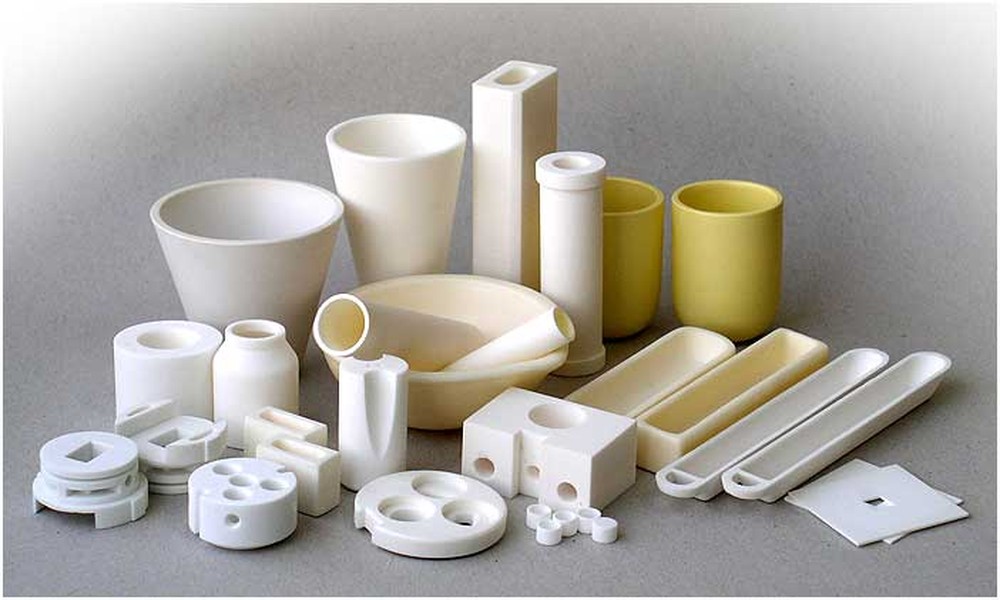
Ceramic injection molding produces dense, wear-resistant components that withstand temperatures, chemical environments and mechanical stresses that would destroy most metals and polymers. Engineers across medical, aerospace, electronics and industrial sectors turn to this process when they need parts that combine hardness, biocompatibility and electrical insulation in geometries too complex for conventional ceramic machining.
The Ceramic Injection Moulding Process
Ceramic injection moulding, often called CIM, follows a workflow similar to metal injection moulding but uses ceramic powder instead of metal. Technicians blend fine ceramic particles, typically zirconia or alumina, with a thermoplastic binder system to create an injectable feedstock. An injection moulding machine forces this feedstock into a precision tool cavity under controlled temperature and pressure, producing a green part that retains the target geometry.
Debinding and Sintering
Debinding removes the binder through a combination of solvent extraction and thermal decomposition. The resulting brown part, fragile and porous, then enters a sintering furnace where temperatures between 1400 and 1700 degrees Celsius fuse the ceramic grains into a fully dense body. Sintered zirconia parts achieve densities above 99 per cent of the theoretical maximum, yielding mechanical properties comparable to those of conventionally pressed and machined ceramics.
Shrinkage during sintering is predictable and uniform, provided the feedstock formulation and moulding parameters remain consistent. AMT’s process engineers account for this shrinkage during tool design, ensuring that finished parts meet dimensional specifications without the need for extensive post-sintering grinding.
Material Properties That Set Ceramics Apart
Different ceramics serve different operational demands. Selecting the right grade determines whether a component performs or fails in service.
Zirconia
Yttria-stabilised zirconia delivers fracture toughness values of 8 to 12 megapascals root metre, a flexural strength exceeding 1000 megapascals and a hardness above 1200 HV. These properties make zirconia the material of choice for dental abutments, surgical blade guides and fibre-optic ferrules.
Alumina and Silicon Nitride
- Alumina offers even greater hardness, reaching 1800 HV, though with lower fracture toughness. Electronic substrate manufacturers specify alumina for its dielectric strength and thermal conductivity, using CIM to produce miniature sensor housings, insulator bushings and high-frequency circuit packages.
- Silicon nitride enters the picture where thermal shock resistance matters. Turbocharger rotors, bearing balls and welding nozzles made from silicon nitride survive rapid temperature cycling that would crack zirconia or alumina equivalents.
As Ms Jacqueline Poh, former Managing Director of the Infocomm Media Development Authority of Singapore, remarked, “Singapore’s advanced manufacturers are proving that ceramics and composites can deliver performance gains once thought reserved for exotic metals.”
Applications in Medical Devices
The medical device sector values ceramics for their biocompatibility and resistance to corrosion by bodily fluids. Key medical applications include:
- Zirconia dental implant abutments that connect a titanium fixture embedded in the jawbone to the visible crown, providing a tooth-coloured interface that blends with natural dentition.
- Ceramic blades for disposable surgical instruments that maintain a cutting edge far longer than stainless steel equivalents, reducing blade changes during lengthy procedures.
- Endoscope distal-tip components moulded from zirconia that resist the abrasive cleaning and sterilisation cycles eroding polymer alternatives.
AMT produces these components under ISO 13485-certified quality management, ensuring traceability from raw powder through moulding, sintering and final inspection. The company’s cleanroom assembly capability allows it to package sterile ceramic components ready for integration into finished medical devices.
Applications Beyond Healthcare
Ceramics serve demanding roles outside the medical sphere.
Semiconductor and Industrial
In semiconductor manufacturing, alumina nozzles and chucks withstand the corrosive plasma environments inside etching and deposition chambers. Zirconia valve seats in chemical processing plants resist erosion by abrasive slurries that would score hardened steel within weeks.
Telecommunications
Fibre-optic ferrules, the small cylindrical components that align glass fibres inside connectors, represent one of the highest-volume CIM applications. Telecommunications companies consume billions of these ferrules each year, each one requiring sub-micrometre concentricity between the fibre bore and the outer diameter.
Aerospace
Aerospace engineers specify ceramic thermal barrier coatings and hot-section components for turbine engines. While plasma spray remains the dominant coating method, CIM enables the production of discrete ceramic inserts and combustor liners in shapes that plasma spray cannot replicate.
AMT’s Ceramic Injection Moulding Capabilities
AMT operates dedicated CIM production lines at its Singapore facility, separate from its metal injection moulding and additive manufacturing operations. Dedicated lines prevent cross-contamination between metal and ceramic powders, a critical quality requirement for medical and electronics applications.
Tooling and Sintering
The company’s CIM toolroom designs and builds multi-cavity moulds capable of producing hundreds of parts per hour. Mould flow simulation guides gate placement, runner sizing and cooling channel layout, reducing trial iterations during tool commissioning.
Sintering furnaces at AMT operate under air or controlled atmospheres, depending on the ceramic grade. Precise temperature profiling, with ramp rates controlled to within two degrees Celsius per minute, ensures uniform shrinkage and prevents warping or cracking in thin-walled geometries.
Post-Sintering Finishing
Post-sintering finishing options include diamond grinding for tight-tolerance surfaces, lapping for optical-grade flatness and laser marking for part identification. AMT’s inspection laboratory uses coordinate measuring machines, surface profilometers and scanning electron microscopy to verify dimensions, surface quality and microstructure.
Choosing CIM Over Alternative Methods
Dry pressing and green machining produce ceramic parts at lower tooling costs but struggle with complex three-dimensional geometries. CIM excels when a part features internal channels, thin walls, undercuts or features on multiple faces that would require numerous machining setups.
At production volumes above a few thousand pieces per year, CIM’s per-unit economics outperform machining from sintered blanks. The process delivers repeatable quality at scale, and the ceramic injection molding expertise that AMT has built over decades of production ensures clients receive parts optimised for performance and cost.