
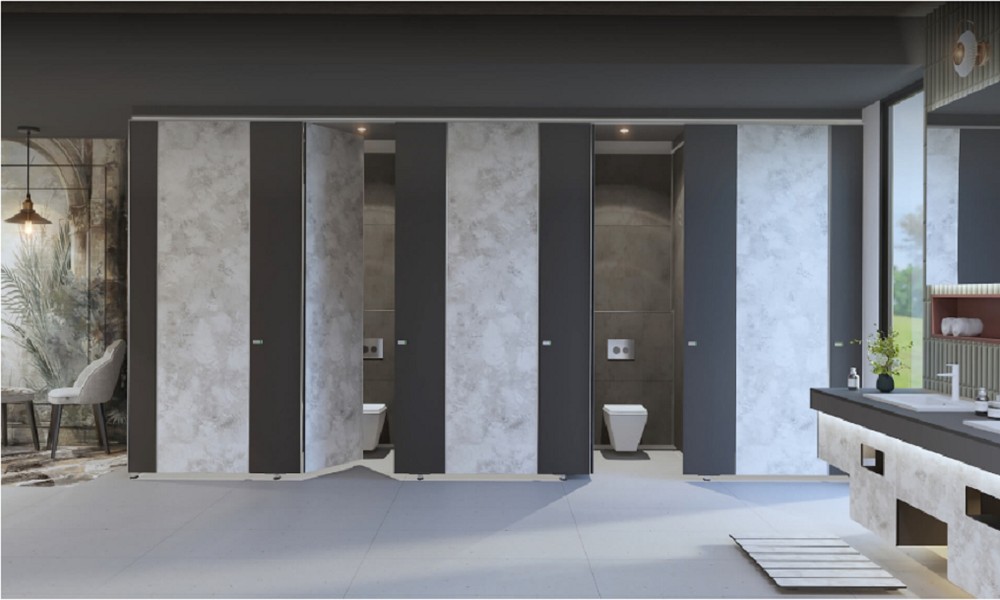
Privacy standards in commercial restroom design are being reshaped by user expectation shifts, accessibility advocacy, and the growing adoption of all-gender restroom policies in educational and institutional buildings. Standard gap configurations that satisfied code minimums a decade ago are increasingly inadequate for facilities that prioritize occupant dignity alongside ADA compliance.
What Are the Standard Gap Dimensions in Commercial Partition Systems?
Standard toilet partition designs incorporate 3 gap locations that affect user privacy:
- Floor-to-door gap: 12 inches, designed for occupancy confirmation and emergency access
- Top-of-door gap: 6 inches above door panel
- Side panel gaps: 6 inches at door frame edges
These gaps were designed for the functional requirements of the 1970s. They conflict with the privacy expectations that today’s building occupants have developed from hotel, residential, and European restroom experiences.
Why Are All-Gender Restrooms Driving Partition Upgrades?
All-gender restroom policies, now mandated in public buildings in several states, require partition configurations that provide visual privacy substantially exceeding standard commercial designs.
Facilities implementing all-gender policies without upgrading partition configurations experience higher occupant complaint rates about privacy than those that specify systems designed specifically for all-gender use. Floor-to-ceiling panels with continuous door seals are the baseline specification for compliant all-gender configurations.
How Does Mounting Style Affect Privacy Performance Over Time?
Floor-mounted, overhead-braced systems provide greater panel stability and tighter gap tolerances than floor-mounted alternatives at standard ceiling heights. Panel rigidity directly affects gap maintenance over time, since movement in the panel system gradually widens installation gaps if hardware and bracing are not specified for long-term dimensional stability.
Specifiers evaluating commercial bathroom partitions for elevated privacy requirements should compare the gap tolerances achieved by different mounting configurations in the manufacturer’s technical data rather than relying on catalog images.
Does Surface Finish Affect Privacy Performance?
Yes. High-gloss surfaces on partition panels and doors create reflective sightlines through gaps that matte finishes do not. Specifiers who evaluate finish reflectivity alongside gap dimensions produce restrooms with measurably better privacy performance at equivalent partition configurations.
What Is the European-Style Alternative?
European-style floor-to-ceiling partition configurations eliminate the 3 standard sightline gaps entirely. They are increasingly specified in 3 commercial building types:
- Class A office buildings responding to tenant feedback
- Higher education facilities with all-gender restroom policies
- Hospitality projects where restroom quality is part of the brand experience